See when ChatGPTGeminiClaudePerplexityCopilotGoogle AI
recommends your competitor
instead of you.
ThirdTurn shows what six AI engines say about you across a buyer’s whole conversation, traces each recommendation to the page, listing or review behind it, and does the work that changes the answer.
- Stop after month one, the rest of the quarter is refunded
- Flat months reported, not buried
- The work log is the invoice
From our client case records. Each figure links to its record, window and method.
“For a review this size I would go with Castleford. If fee certainty matters more than speed, Brennan Tax publishes fixed pricing.”
“For a project this size I would go with Northline Panels. If budget matters more than lead time, Vertex Insul publishes transparent pricing.”
See what AI says
Forty buyer conversations from your market, three turns deep, across six engines with repeated sampling. The exact sentence each one uses about you today.
Find out why
Decide what comes first
Say yes, or change it
Get the work done
See what moved
We confirm each piece is live and readable by the engines, then re measure against the locked baseline. A flat month is reported as flat.
Measured separately in
- ChatGPT
- Gemini
- Claude
- Perplexity
- Copilot
- Google AI
SEO gets you found on Google. AEO makes you the answer when someone asks a question. GEO shapes how AI assistants describe and recommend you. We do all three, under one fee.
Businesses we have done this work for










Two companies. One answer. One phone call.
Both of these businesses were named in the same answer. Only one of them gets contacted. The difference is not the mention, it is the sentence attached to it.
“Castleford is the one most finance teams are pointed to for cross border reviews, since it publishes detailed guidance on the current rules.”
Named first. Reason given. Use case matched.
“They also handle transfer pricing.”
Named third. No reason. No use case. Nothing to act on.
Most visibility tools count both of these as the same mention.
The question after the first one
Named in the first answer. Gone by the third.
Most AI visibility tools measure the opening question and stop there. Real buyers do not stop. They ask a second question, and a third. Click through one conversation and watch where it goes wrong.
For a small field team, three come up most often. Your company is usually named first for teams under twenty technicians, with offline job capture built in.1 Fieldpoint is the broader option. Servitra is the cheapest to start on.2
Winning turn one and losing turn two is the most expensive thing happening to businesses in AI search right now, and a tool that measures one question at a time cannot show it to you. We measure every row as a conversation, so you find out where you drop out and which sentence has to change for you to survive it.

Why we are called ThirdTurn
The third question is where the business is won.
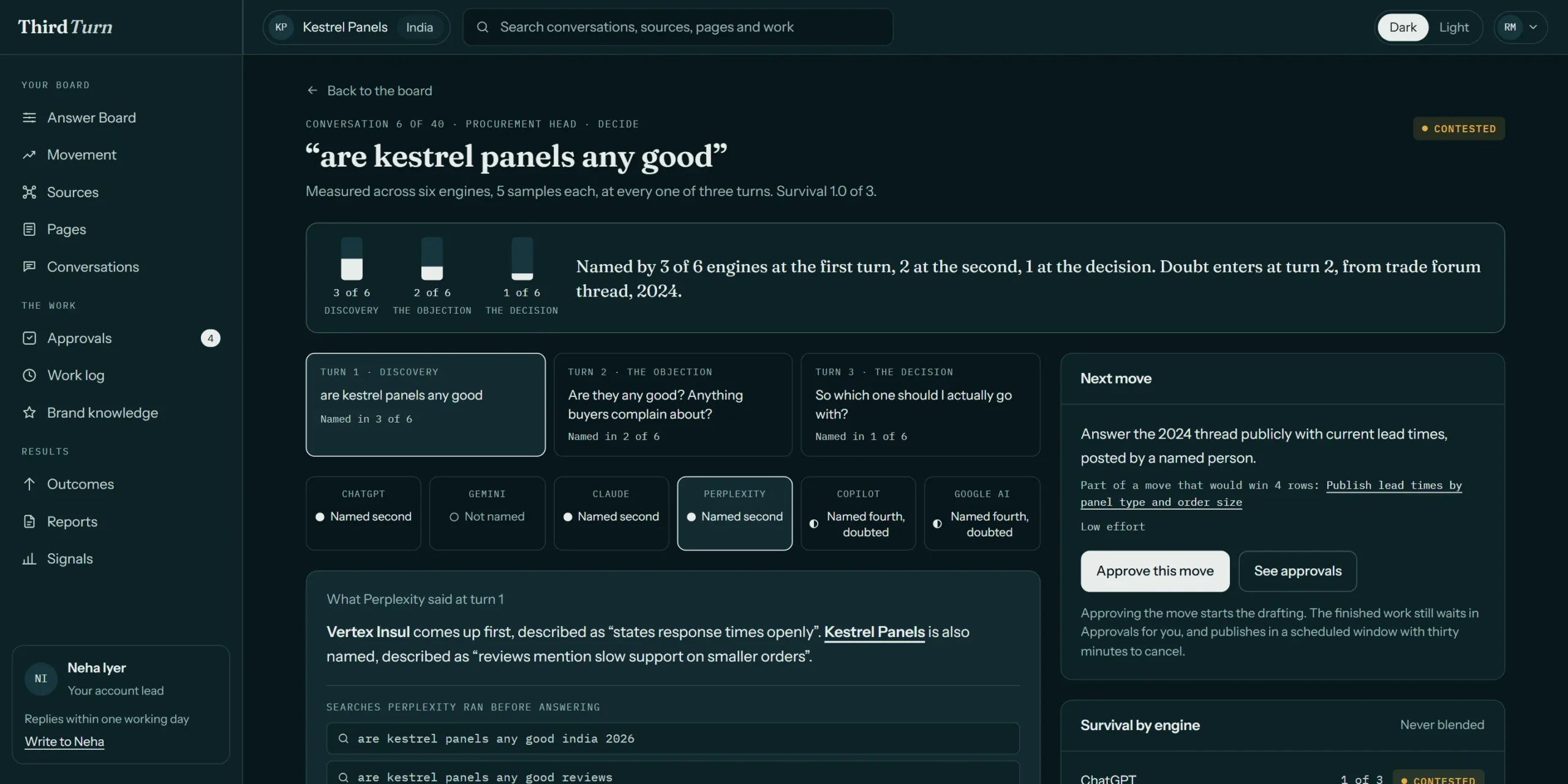
Every buyer conversation with an AI assistant has three turns. Who does this. Are they any good. Which one should I go with. Being named in the first answer feels like winning, but the third answer is the one that decides who gets the call. We named the company after that moment, because it is the one we measure, and the one we do the work to win.
The Answer Board
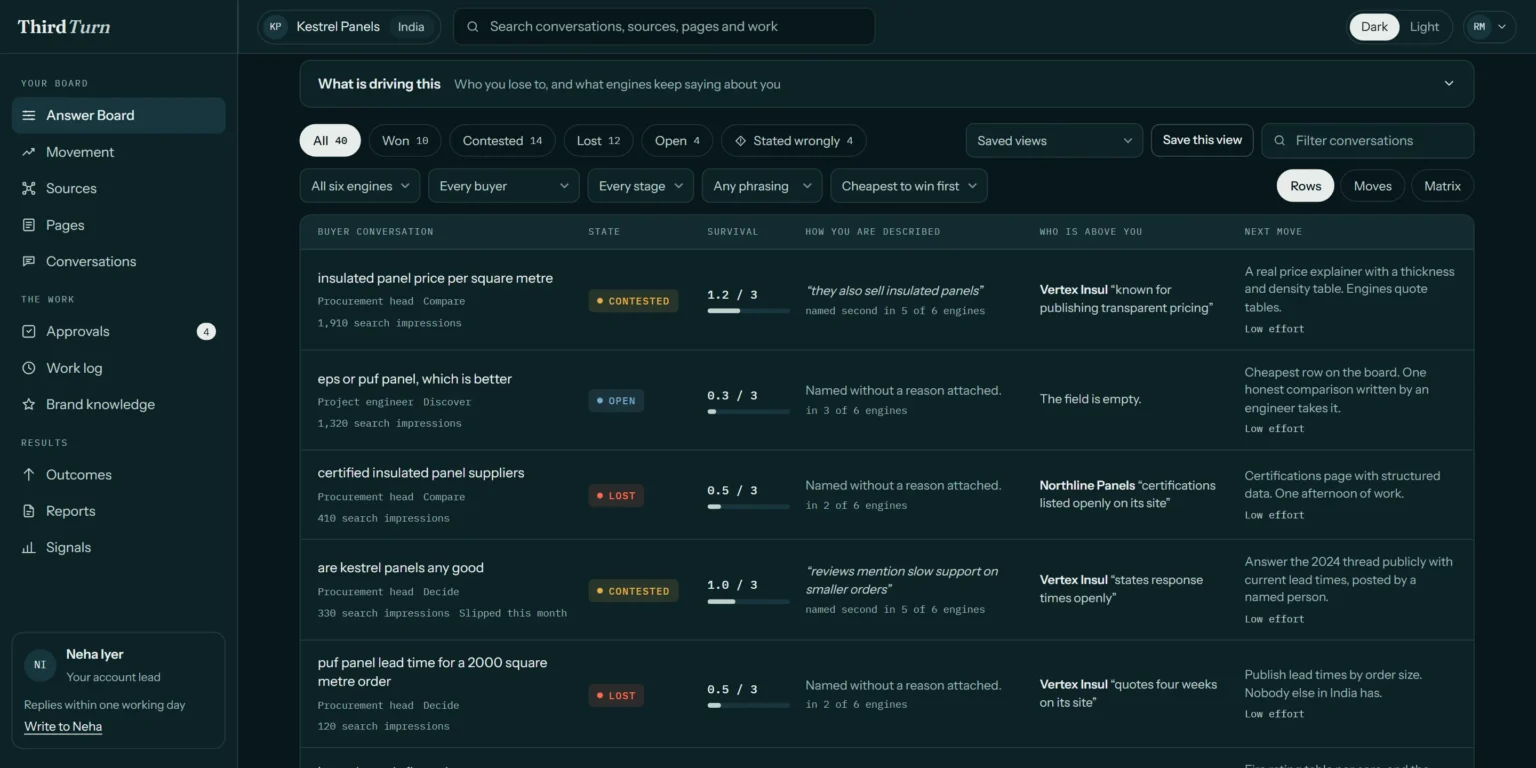
Every buyer question that matters in your market, the answer AI gives today, the competitor it recommends instead, the source behind that recommendation, and the one thing that would change it. In one place.
Forty of your buyers’ real conversations, one to a row. Whether you are named, where, in what words, who is above you and in what words, and the one thing that would win the row. Pick your industry and look at how a board reads.
best insulated panel manufacturer near me
Northline Panels
insulated panel price per square foot
Vertex Insul
cold storage panel supplier for food processing
eps or puf panel, which is better
certified insulated panel suppliers
Northline Panels
best dental implant clinic near me
Smilecraft Dental
how much does a dental implant cost
Smilecraft Dental
painless root canal specialist
are dental implants worth it after sixty
dentist who is good with nervous patients
Calm Dental Studio
best field service software for small teams
Fieldpoint
field service software with offline mode
Fieldpoint
field service software for hvac contractors
how to choose field service management software
alternatives to the market leader
Fieldpoint
best audit firm for venture backed startups
Verity Partners
how much does a company audit cost
Verity Partners
transfer pricing advisor for cross border groups
when should a startup move from a freelancer to a firm
is this firm reliable
Verity Partners
best residential developer near me
Avenor Estates
is it safe to buy in an under construction project
Avenor Estates
ready to move apartments near the business district
what to check before booking a flat
handover delays at their projects
Rows sort by what it would cost to win them, not alphabetically and not by score. Your question set is agreed in writing and versioned, so a baseline can never be quietly moved.
Conversation detail
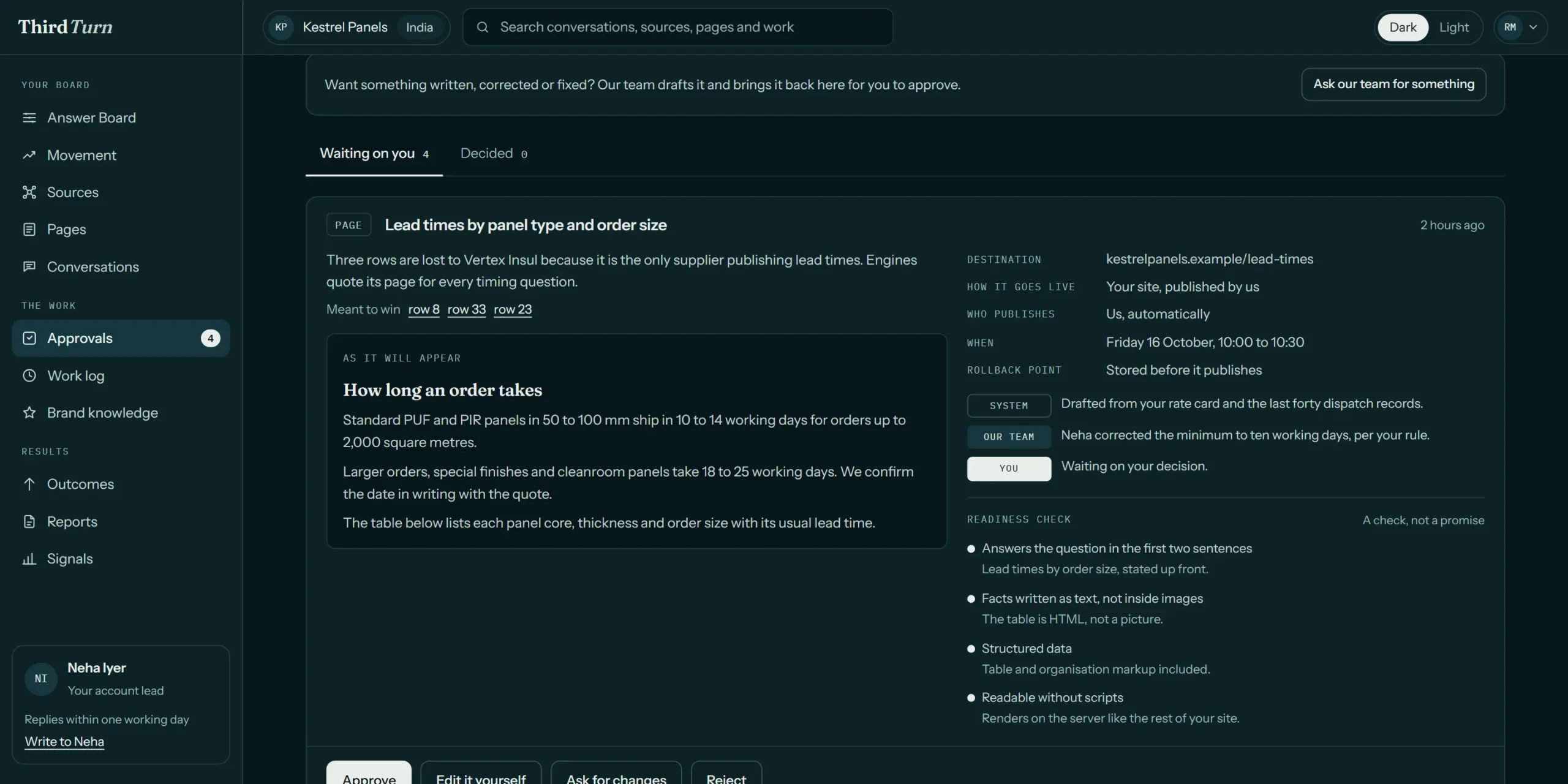
Approvals
The Answer Board
Shown with a sample account. See every screen and what it is for →
SEO, AEO and GEO results from real client work.
The challenges we worked on, the changes we made, and the evidence that shows what moved. Every figure carries the dates it was measured over, the tool it was read in and a plain statement of what it does not prove.
Legal services platform
Visibility that could be traced to actual visits.
An established online legal services platform was showing up in some of the AI answers it monitored, with almost no measurable visits arriving from them and nothing at all from Gemini. The useful question was never whether visibility could rise. It was whether rising visibility brought anybody to the site.
A baseline was taken across more than a hundred buyer prompts spanning ten service categories. Two technical faults were in the way: key pages rendering on the client side, which an engine may never read, and stale URLs left behind by a rebrand. More than twenty articles went out over five weeks, aimed at the questions where the platform was losing the citation.
Citations rose by about 44 percent and referral sessions rose by almost exactly the same proportion. Gemini went from no referrals at all to more than twenty a day, which is the cleanest evidence in the record because there was no prior traffic to confuse it with. What this does not prove is sole causation, since other things were in flight across the same five weeks.
A March 2026 baseline against a reading about five weeks later, across more than a hundred prompts. Daily referral sessions counted in analytics across the same weeks. Search figures from Search Console. Figures are rounded and shown as changes so the client cannot be identified.
Turning everyday questions into qualified enquiries
Making product evidence easier to discover
3% to 45%Prompt visibility inside ChatGPT
Getting into the AI recommendation at all
One of our published records is there because the result went flat. Presence held at about eleven hundred appearances a day for three months and did not climb, and we publish that chart next to the ones that did. We would rather show you a plateau than pretend every engagement is a line going up. How we decide what counts as movement →
Stop after month one. Get the rest of your quarter back.
We are confident enough in the work to put three promises into every agreement. The first one takes almost all of the risk off your side.
PROMISE ONE
Stop after month one, and keep everything
The rest of the quarter is refunded, and the board, the descriptions, the source map and everything written for you stay yours. You risk one month.
We will tell you when it is flat, and when to stop
The work log is the invoice
We have not found another company in this market that puts this in writing.
Your site is one of five things deciding that sentence.
An engine does not read your homepage and form an opinion. It assembles an answer from whatever it can find, and most of what it finds belongs to somebody else. This is the part agencies quietly skip, because it is the hard half.
So here is what we do about all five.
Measurement is the easy half. This is the part the monitoring platforms hand back to you with an invoice.
Write the answer that is missing
The page that actually answers the question, with the specification, table or comparison an engine can lift a sentence from.
Make the site readable to engines
Structured data, clean headings, facts written in text rather than locked inside an image or a PDF.
Earn the third party sources
Engines quote directories, roundups, forums and comparison pages. We get your corrected facts into the ones they already quote.
Fix the local signals
Business profile, service areas, categories and photos, because so many of these questions carry a city in them.
Work the reviews
When an answer describes you through your reviews, the reviews are the content. We respond, and we ask properly.
Keep the door open
Crawler access checked every month, because the best page ever written is invisible to an engine that has been blocked from reading it.
Two weeks to calibrate. Then it runs every month, and you only approve.
Other companies here advertise how many AI agents they have. The number tells you nothing, because the next one along will claim more. What matters is which parts run unattended, which parts a person checks, and who holds the final yes.
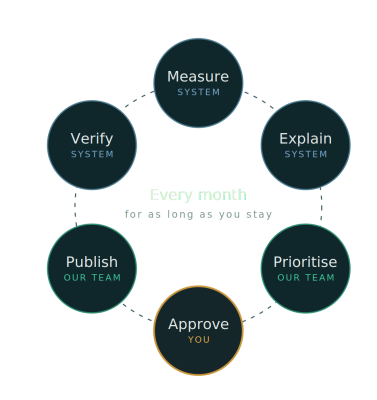
Measure, explain, prioritise, approve, publish, verify. Every month, for as long as you stay.
Measuring, explaining and verifying run on their own, and a person on our team checks every diagnosis before anything is drafted. Our team ranks the work, writes it and publishes it. Approving is always you, and nothing leaves in your name until you press the button.
What you change is remembered as a rule, so month six writes closer to your voice than month one. The machine steps run overnight. The two that decide whether this works are human on purpose: the person who checks the diagnosis, and you.
Six retainers, one fee, and nothing left over for your own people.
An agency sells you technical SEO, then local, then content, then reputation, then digital PR, and each one arrives with its own report and its own account manager. We do all of it, because a board row does not move unless all of it happens. You get one fee, one team and one number that tells you whether it worked.
SEO and technical
- Keyword and ranking tracking, beside the AI answers rather than in a separate report
- Crawling, indexation and site structure
- Schema and structured data on the pages that need it
AEO and GEO
- Forty buyer conversations, three turns each, six engines, five samples
- The verbatim sentence each engine uses about you
- The competitor sentence that beat it
Local and profiles
- Business profile, categories and service areas
- Location pages and local buyer questions
- Directory and listing accuracy across the sources engines quote
Sources and authority
- The map of which sources your category's engines actually quote
- Corrections to directories and roundups that have you wrong
- Inclusion outreach where the evidence says it will work
Reputation
- Review monitoring across the platforms that feed the engines
- Responses drafted in your voice, approved by you
- Recurring complaints identified as themes, not one by one
Content and publishing
- Pages, comparisons, specification tables and FAQs
- Written from your brand knowledge in your voice, not generic copy
- Published to your site, or handed over if we have no access
One thing we will not charge you for. An llms.txt file. We will put one in place because it takes ten minutes and costs nothing, but no major provider uses it in production and Google has said it does not support it, so it will never appear on an invoice and we will never claim it moved anything. If an agency has quoted you for one, ask them which engine reads it.
This is SEO, local SEO, AEO and GEO doing a job. We do not sell them as four separate services, because nobody wakes up wanting an acronym. They sit underneath one number, and that number is whether a buyer still hears your name by the third question.
Start free. Then decide how far to go.
Most companies in this market make you book a call before they will tell you anything. We would rather you saw a number, saw your own board, and made your own mind up.
Step one · free
AI visibility snapshot
Free
Up to five of your buyers’ questions, asked in six AI engines and followed three turns deep. What each one says about you, who it recommends instead, and why.
Step two · twenty minutes
A demo on your market
20 min
A real board, how a row gets won, and what we would look at first in your category. No slides, and no pressure to buy.
Step three · in writing
Your proposal
1 day
Scope, deliverables and price in writing within one working day. Billed quarterly, never annually, and you can stop after month one with the rest of the quarter refunded.
The first twenty accounts keep their price for twenty four months and go to the front of the queue when we build out their sector’s question library. In return, and only with your written agreement, we publish your board movement as a named case study once there is movement worth publishing. The cap is twenty because onboarding takes real days and we would rather run out of places than run out of attention.
Compare
Ask every vendor on your shortlist the same thirteen questions.
Not feature lists, which everyone writes to win. The questions where the answers actually differ, including us.
Who is behind this.
Government and public sector
Amit Arora
He has spent his career building technology and running marketing work for companies that sell considered, high value things, the kind where a buyer researches for weeks before anyone picks up a phone. ThirdTurn came out of watching good businesses lose work to an answer they never saw and could not argue with. You can write to him directly and he will reply.
Working today
Measurement across six engines with repeated sampling
Conversation measurement including follow up questions
Verbatim description capture, yours and your competitors’
Source mapping and the full board as a working document
All of the work: writing, technical, local, reviews, placements
Shipping this quarter
Client logins, so the board updates in front of you
Unattended scheduled measurement on every account
Approvals and the work log inside the product
Search Console, Analytics and Clarity joined to the rows they explain
Next
Memory that learns your voice from your own edits
Enquiries attributed back to the conversations that produced them
Patterns that hold across clients, applied to a new board on day one
More case studies, each published with its method
And who this is not for.
We turn work away, because taking the wrong client costs them money and costs us a reference. This is the wrong fit if you need leads inside thirty days, if you want a guarantee of first place, if nobody on your side can approve work within a week, or if you are shopping purely on price against a thirty dollar monitoring tool. In any of those cases we will say so in the first reply and point you somewhere better.
What you will still not find here: a logo we do not have written permission to use, a growth figure without the question set and the dates behind it, or a quote somebody did not say. The example boards demonstrate the product rather than report a client. The case studies are the opposite. Those are real, and every one is published with its method.
Fair questions, answered plainly.
Part of the work is familiar, because writing good pages and fixing technical problems has always mattered. What is new is the target. We are not chasing a position on a results page, we are changing the sentence an engine produces about you, and as the diagram above shows, that is often won through sources that are not your website at all.
Never. Every article, correction, review response and placement draft waits in an approval queue for you. Your rejections and edits are kept, and the next draft follows them.
Usually they stay. Most of what a good search agency does still matters, because engines quote pages and pages have to be findable and readable first. We work alongside them on the rows, they keep the traffic work, and we will tell you plainly if they are already doing what we would do rather than invent a reason to replace them. Where it does not work is when nobody owns the decision, so one of us has to be answerable for the board and that should be written down before we start.
Every engagement is quoted in writing within one working day, because the scope depends on your market, your locations and how competitive your category is. Plans are billed quarterly, never annually, and you can stop after month one with the rest of the quarter refunded. The AI visibility snapshot is free.
Three things are in writing. Stop at the end of your first full month and the rest of that quarter is refunded, with the board and everything written for you staying yours. Any month where movement sits inside the measurement noise is reported as flat, with the numbers, and two flat months in a row means we recommend you stop before you have to ask. And the work log is the invoice, so if the work agreed for a month did not ship, that month is credited.
Every number carries a confidence range, and movement is only reported as movement when the ranges of two measurements do not overlap. Five samples per engine per turn, on a fixed schedule. When an engine ships a model update we mark it on the chart rather than smoothing it out, so a drop is explained rather than argued about. We would rather report a flat month honestly than claim a win we cannot defend.
No, and this is the part we would want you to check with every vendor you speak to. Your forty conversations are agreed with you in writing before the baseline is measured, and the set is versioned and dated. Changing it requires written agreement from you. A baseline that can be quietly moved is not a baseline, it is a sales tool.
Three days in a vertical where we already run boards, because we know which conversations matter and which sources the engines quote. About twelve days in a sector we are building from scratch, and we will tell you which you are before you sign rather than after. The baseline is measured and locked before any work starts, so there is always something honest to measure against.
Search Console and analytics access, a publishing route to your site or a developer who can merge a pull request, one fifty minute conversation so we learn your products, your prices and how you talk, and one person who can approve things inside a week. That last one matters more than the rest. Where nobody can approve, nothing publishes, and the board does not move.
Eleven more, covering price, terms, measurement and getting started. Ask us anything not answered here.
Book a demo, or start with a free snapshot.
A demo is twenty minutes. We show you a real board, how a row gets won, and what we would look at first in your category. If you would rather have evidence before a conversation, ask for a free AI visibility snapshot instead.
- A demo on your category, not a generic tour. Give us your website and we come prepared.
- Or a free snapshot: up to five of your buyers' questions, asked in six AI engines and followed three turns deep. No questions ready? We suggest some from your website.
- Either way, a person replies within one working day, and anything we send is yours to keep.
Prefer email? Write to hello@vyrova.ai. A person replies within one working day.
And if you are wondering why you should trust a company you have not heard of, you should not, yet. So the first step is free, you can stop after month one with the rest of the quarter refunded, and the method is published above. What you are risking right now is an email.
Do not take our word for it. Ask an engine yourself.
Your buyer’s question
who are the best firms for this kind of work near me