Buyers ask who to trust before they ask what is for sale.
Somebody relocating asks an assistant which areas suit their budget, then which agents actually know that market, then who they should call. The names that come back are the ones an engine can resolve as a real, consistent business with corroboration behind it. Listings portals are not the problem. Being unreadable as an entity is.
- See the exact sentence six AI engines return about your business today.
- See which competitor is recommended instead of you, and in whose words.
- See the page, listing or review that caused it, and what would change it.
Get a free AI visibility snapshot
Free, inside forty eight hours, and yours to keep whether you buy or not.
No charge, no card, no contract. A person replies within one working day and the snapshot is yours whether you buy or not.
an AI visibility snapshot on your questions
Example rows from an illustrative real estate and property board.
Yours will carry your own services, your own competitors and your own market, but the shape is the same everywhere we have measured in this sector.
Answer Board · residential brokerage
Survival 0.8 of 3
Illustrative
BUYER CONVERSATION
best estate agents for the north side
Lost
0.0 / 3
Not named. Two portals and one national chain supply the whole answer.
agent who specialises in period properties
Lost
0.0 / 3
The specialism is real and appears nowhere on a readable page.
what commission do agents charge here
Contested
1.0 / 3
“fees vary by agent” · no figure published, so the answer stays generic and names nobody
is this brokerage reputable
1.5 / 3
Review presence is thin and inconsistent across platforms, so corroboration fails at the decision turn
agents who publish actual sold prices
Named first for the one thing it documents, and it survives all three turns
Illustrative board built from a real question set. Not a client’s data.
It is almost never the website.
REASON 01
You are not resolvable as an entity
Different trading names, inconsistent addresses and no structured data mean an engine cannot be sure you are one business. The published brokerage record on this site treats that as the first problem to fix, before any content work.
REASON 02
Reviews are the corroboration that decides it
An assistant deciding whether to recommend a brokerage looks for consistent outside evidence. Thin or contradictory review presence is usually what loses the third turn.
Portals answer the questions you should be answering
Area guides, fee explanations and process walkthroughs get quoted from portals because brokerages leave them unwritten. Each one is a row you could hold.
Most of these sources are not your website.
These are the source types the engines quote most in this sector. Working only on your own site means working on about twenty percent of the problem.
Property portals
They hold the area guides, the fee explanations and the process walkthroughs, which is why they get quoted instead of you.
Local news and area coverage
Market commentary a brokerage is quoted in is durable corroboration, and far more useful than it looks.
Review platforms and business profiles
The corroboration layer. Thin or inconsistent presence here is usually what loses the decision turn.
Structured data on your own site
Organisation and person markup, a consistent address, and an entity an engine can resolve without guessing.
One fee. Six workstreams. One log.
An agency sells these as five retainers with five reports and leaves the hard half undone. The full list is here, and there is one fee for all of it.
The measurement
The diagnosis
The work itself
The approval queue
The verification
The work log
The Answer Board
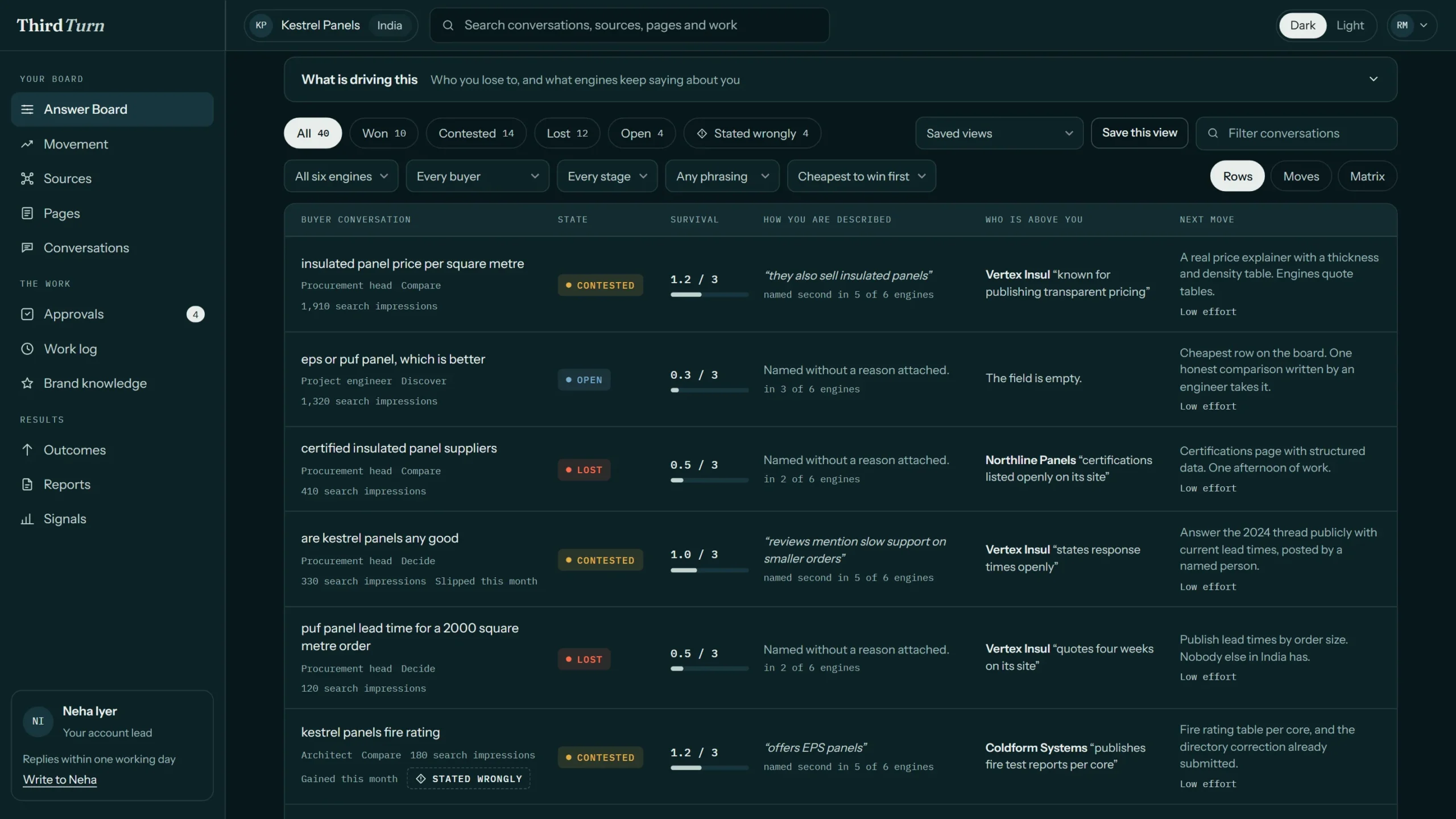
Shown with a sample account.
The records closest to this sector.
Every figure carries the dates it was measured over and a plain statement of what it does not prove. Every figure carries its dates, its source and what it does not prove.
The questions this sector always asks.
No. Listings are already handled by portals. This is about whether your firm is named when somebody asks who to use, which is a different question and usually an earlier one.
Correct, and it says so in amber at the top of the page. We kept it because the sequence it describes, entity and schema first, then consistent facts, then content, matches what we see in our own measurement.
Entity and review work tends to show up slower than content work and lasts longer. Judge it at three months, not three weeks.
Yes, and the equivalent profiles elsewhere. Consistency across them is worth more than perfecting any single one.
This is the wrong fit if you need leads inside thirty days, if you want a guarantee of first place, if nobody on your side can approve work within a week, or if you are shopping purely on price against a thirty dollar monitoring tool. We will say so in the first reply and point you somewhere better.
See what AI tells your
buyers about you.
Add up to five questions your buyers ask, or leave them blank and we will suggest questions from your website for you to confirm. We ask each one in six engines, follow it three turns deep, capture the sentence each engine uses about you and name who is recommended instead.
- No charge, no card and no contract for the first five rows.
- You keep the rows whether you buy anything or not.
- If we think you are the wrong fit, we say so in the first reply.
Request your free snapshot
Add your questions if you have them. If not, we suggest some from your website and confirm them with you first. A person replies within one working day.
No charge, no card, no contract. A person replies within one working day and the snapshot is yours whether you buy or not.
Five rows of your own board, free. Six engines, back inside 48 hours, yours to keep.