Cover is compared in a conversation you never see.
Somebody weighing a policy asks an assistant what cover they actually need, then asks what the usual exclusions are, then asks who to buy from. Aggregators answer the first two questions and therefore decide the third. Brokers and insurers who explain exclusions plainly on their own pages are the ones that start getting named.
- See the exact sentence six AI engines return about your business today.
- See which competitor is recommended instead of you, and in whose words.
- See the page, listing or review that caused it, and what would change it.
Get a free AI visibility snapshot
Free, inside forty eight hours, and yours to keep whether you buy or not.
No charge, no card, no contract. A person replies within one working day and the snapshot is yours whether you buy or not.
an AI visibility snapshot on your questions
Example rows from an illustrative insurance board.
Yours will carry your own services, your own competitors and your own market, but the shape is the same everywhere we have measured in this sector.
Answer Board · commercial insurance broker
Survival 0.8 of 3
Illustrative
BUYER CONVERSATION
brokers for this type of commercial cover
Lost
0.0 / 3
Not named. Two aggregators and one national broker supply the whole answer.
what is usually excluded from this policy
Lost
0.0 / 3
Exclusions are in a policy document nobody can read, so an aggregator explains them.
how much should this cover cost
Contested
1.0 / 3
“quotes vary” · no indicative range anywhere, so the row stays generic
broker who handles claims disputes
1.2 / 3
“also assists with claims” · no outcomes or process detail, so it loses the decision turn
who explains the exclusions in plain words
Named first for the explainer itself, and it carries through all three turns
Illustrative board built from a real question set. Not a client’s data.
It is almost never the website.
REASON 01
Aggregators own the explanation
Whoever explains cover and exclusions gets quoted, and right now that is an aggregator with no interest in sending the enquiry to you.
REASON 02
Policy documents are unreadable
The real detail sits in a PDF written for a regulator. Publishing a plain explanation alongside it is one of the cheapest rows available in this sector.
Claims experience is never evidenced
Everybody says they help at claim time. Almost nobody publishes the process, the typical timeline or anything a buyer can check.
Most of these sources are not your website.
These are the source types the engines quote most in this sector. Working only on your own site means working on about twenty percent of the problem.
Aggregators and comparison sites
They hold the explanation of cover and exclusions, which is why they get quoted instead of you.
Regulator and ombudsman listings
Confirm who you are and what you may sell. Engines lean on them for trust questions.
Consumer forums and claims threads
Where claims experience is actually discussed, often by people who never heard back from anyone.
Your own plain language explainers
Exclusions, indicative ranges and the claims process, written for a person rather than a regulator.
One fee. Six workstreams. One log.
An agency sells these as five retainers with five reports and leaves the hard half undone. The full list is here, and there is one fee for all of it.
The measurement
The diagnosis
The work itself
The approval queue
The verification
The work log
The Answer Board
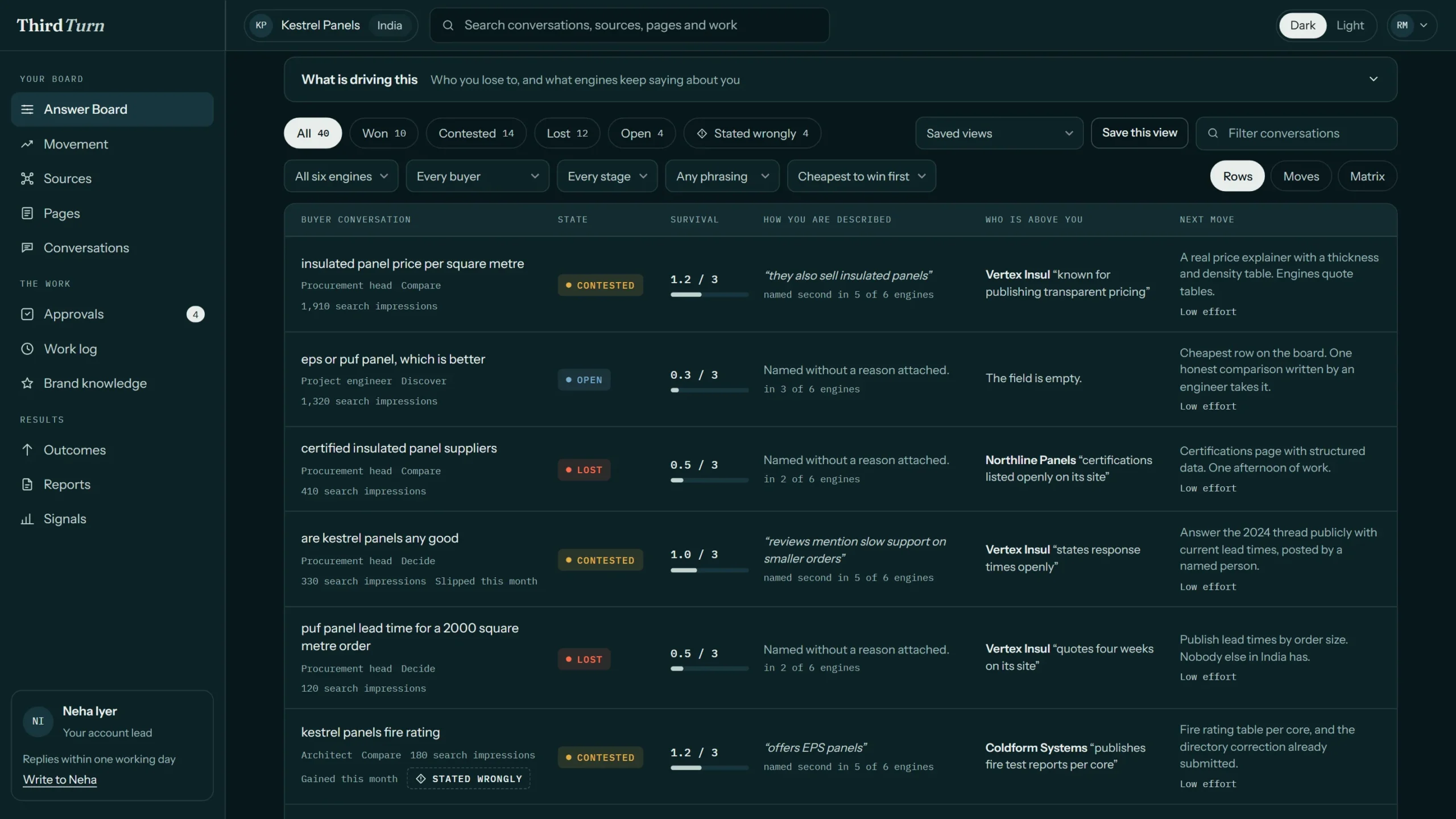
Shown with a sample account.
The records closest to this sector.
Every figure carries the dates it was measured over and a plain statement of what it does not prove. Every figure carries its dates, its source and what it does not prove.
Professional services · Case 08
Connecting AI visibility to measurable site visits
+44% total ai citations
Professional services · Case 06
Building visibility around one specialist practice
+32.2% ai overview impressions in 28 days
We have not published a record in this sector yet
What is shown here is the nearest we have. Ask for a free snapshot from your own market and judge the method on your own questions instead of on a case study.
The questions this sector always asks.
Correct, not yet in insurance. The nearest records are in regulated professional services, where the same pattern holds.
Often yes, as a range with the factors that move it. That is usually enough to take the cost row back from an aggregator.
Then the explainer content gets reviewed at renewal, which is a scheduled job rather than a rewrite. The underlying questions buyers ask barely change.
No. It competes for the conversation that happens before anyone opens an aggregator.
This is the wrong fit if you need leads inside thirty days, if you want a guarantee of first place, if nobody on your side can approve work within a week, or if you are shopping purely on price against a thirty dollar monitoring tool. We will say so in the first reply and point you somewhere better.
See what AI tells your
buyers about you.
Add up to five questions your buyers ask, or leave them blank and we will suggest questions from your website for you to confirm. We ask each one in six engines, follow it three turns deep, capture the sentence each engine uses about you and name who is recommended instead.
- No charge, no card and no contract for the first five rows.
- You keep the rows whether you buy anything or not.
- If we think you are the wrong fit, we say so in the first reply.
Request your free snapshot
Add your questions if you have them. If not, we suggest some from your website and confirm them with you first. A person replies within one working day.
No charge, no card, no contract. A person replies within one working day and the snapshot is yours whether you buy or not.
Five rows of your own board, free. Six engines, back inside 48 hours, yours to keep.