Three products get recommended. The rest are not in the conversation.
A shopper asks an assistant which product suits them, then asks how two of them compare, then asks which to buy. Three names survive to that last question. Everything else was filtered out at the first one, usually because the product facts a buyer cares about were never written on a page an engine could read.
- See the exact sentence six AI engines return about your business today.
- See which competitor is recommended instead of you, and in whose words.
- See the page, listing or review that caused it, and what would change it.
See five rows of your own board
Free, inside forty eight hours, and yours to keep whether you buy or not.
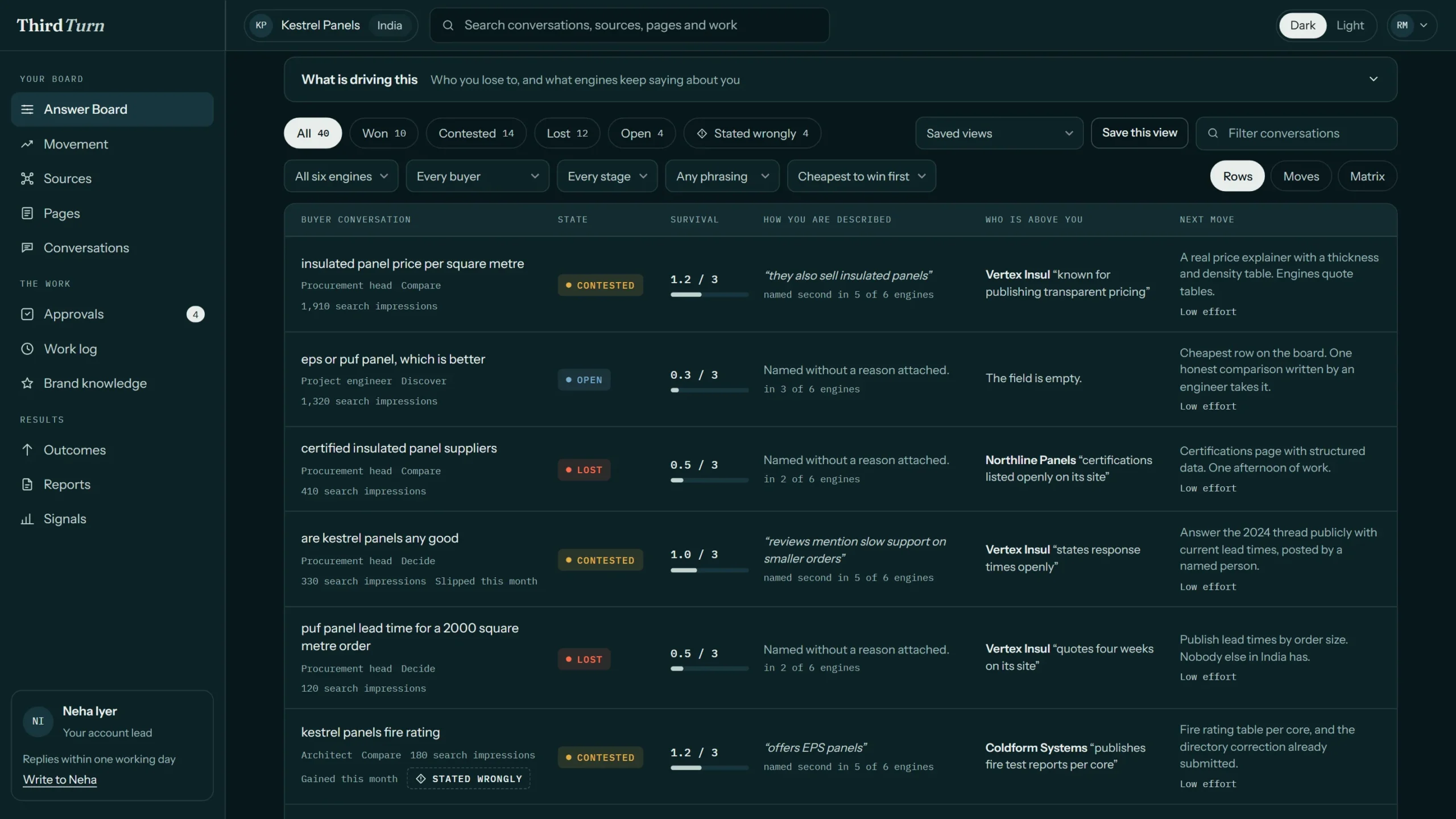
Five rows from a ecommerce and retail board.
Yours will carry your own services, your own competitors and your own market, but the shape is the same everywhere we have measured in this sector.
Answer Board · direct to consumer category
Survival 0.9 of 3
Illustrative
BUYER CONVERSATION
best product for sensitive skin under 1000
Lost
0.0 / 3
Not in the top ten. Two marketplace listicles supply every name in the answer.
compare the two leading brands in this category
0.0 / 3
No comparison content exists, so a review blog decides the comparison instead.
is this ingredient actually proven
Contested
1.0 / 3
“one of the brands using it” · the brand holds a study and never published it readably
which brand do dermatologists recommend
1.2 / 3
“also sold in pharmacies” · corroboration exists offline but not anywhere an engine looks
brands that publish their full ingredient sourcing
3.0 / 3
Named first for the one thing it documents properly, and it holds through the decision turn
Illustrative board built from a real question set. Not a client’s data.
It is almost never the website.
REASON 01
Product pages speak your language, not the buyer's
Internal product names and marketing adjectives are useless to an engine assembling an answer. The questions buyers actually ask need their own pages, which is what moved the wellness retailer on this site to 84.4K appearances inside Google AI features.
REASON 02
Evidence you already own is not readable
Studies, expert credentials and test results sit in images, PDFs or nowhere at all. The direct to consumer record on this site went from 3.3 percent to 44.7 percent visibility inside ChatGPT by organising evidence the brand already had.
Comparison intent is unclaimed
Shoppers ask which of two brands is better, and almost no brand answers that question on its own site. Whoever does gets quoted, and in one fourteen day engagement that was worth a move from outside the top ten to second in the category.
Four of every five sources are not your website.
These are the source types the engines quote most in this sector. Working only on your own site means working on about twenty percent of the problem.
Marketplace listings and roundups
Almost always the dominant source in consumer categories, and almost always listing somebody else. Inclusion is slow and worth pursuing anyway.
Review blogs and comparison sites
They answer the comparison question because brands refuse to. Whoever answers it factually on their own site takes the row back.
Retail and pharmacy stockist pages
Your own channel describing your product in their words, often with the wrong specification or an old formulation.
Your own product and evidence pages
Where the studies, credentials and sourcing live, if they are written in plain words rather than locked inside images and PDFs.
One fee. Six workstreams. One log.
An agency sells these as five retainers with five reports and leaves the hard half undone. The full list is here, and there is one fee for all of it.
The measurement
The diagnosis
The work itself
The approval queue
The verification
The work log
The records closest to this sector.
Every figure carries the dates it was measured over and a plain statement of what it does not prove. Client names are withheld because the agreements say so.
Making product knowledge easier for AI search to cite
Making product evidence easier to discover
Getting into the AI recommendation at all
The questions this sector always asks.
No. It sits next to it. What it changes is whether you exist in the conversation that happens before anyone opens a marketplace.
The innerwear record on this site ran fourteen days with one piece published a day and reached 9.6 percent category share of voice. That is unusually fast and it is a snapshot, not a trend. Treat three months as the honest measure.
Yes, factually. We will not publish a claim about a competitor we cannot evidence, and we will tell you when a comparison you want made is one you would lose.
Ask them for the prompt set and the counting rule. A share of voice figure means nothing without both, which is why ours always travels with the number of prompts tracked.
This is the wrong fit if you need leads inside thirty days, if you want a guarantee of first place, if nobody on your side can approve work within a week, or if you are shopping purely on price against a thirty dollar monitoring tool. We will say so in the first reply and point you somewhere better.
Five questions in. Five rows back.
Tell us five buying questions from your market, the ones a customer would actually type. We run them across six engines with repeated sampling, capture the sentence each one returns, name who is being recommended instead of you, and send the whole thing back inside forty eight hours.
- No charge, no card and no contract for the first five rows.
- You keep the rows whether you buy anything or not.
- If we think you are the wrong fit, we say so in the first reply.
Send your five questions
Five rows of your own board, free. Six engines, back inside 48 hours, yours to keep.